Building an AI First Business Stack
Why your software architecture now needs a central intelligence layer
Most small businesses do not suffer from a lack of tools.
They suffer from a lack of integration and a lack of shared intelligence.
Over time we assemble a stack that looks something like this:
A CRM for sales.
Accounting software for finance.
Docs for delivery.
A whiteboard for workshops.
A task manager for operations.
A meeting recorder for notes.
Each system works.
None of them think together.
That was acceptable when software was just a system of record.
It is not acceptable when software becomes a system of reasoning.
The shift from systems of record to systems of intelligence
AI changes the role of your stack.
Previously, your tools stored information.
Now they are expected to:
• understand context
• recommend next actions
• automate workflows
• generate outputs
• support decision making
If your data is fragmented, your intelligence is fragmented.
This is why AI first businesses need a central brain.
Not multiple AI features scattered across tools, but one reasoning layer that can access all business context.
The principle, avoid siloed intelligence
We already learned to avoid siloed databases.
We created integrations, data warehouses, and reporting layers.
Now we need to avoid siloed intelligence.
If your CRM has one AI, your task manager has another, and your docs have a third, you do not have an AI strategy.
You have multiple disconnected copilots with partial context.
The goal is a single intelligence layer that can:
• read across systems
• reason over combined data
• trigger actions in the right platform
• maintain organisational memory
My current AI first architecture
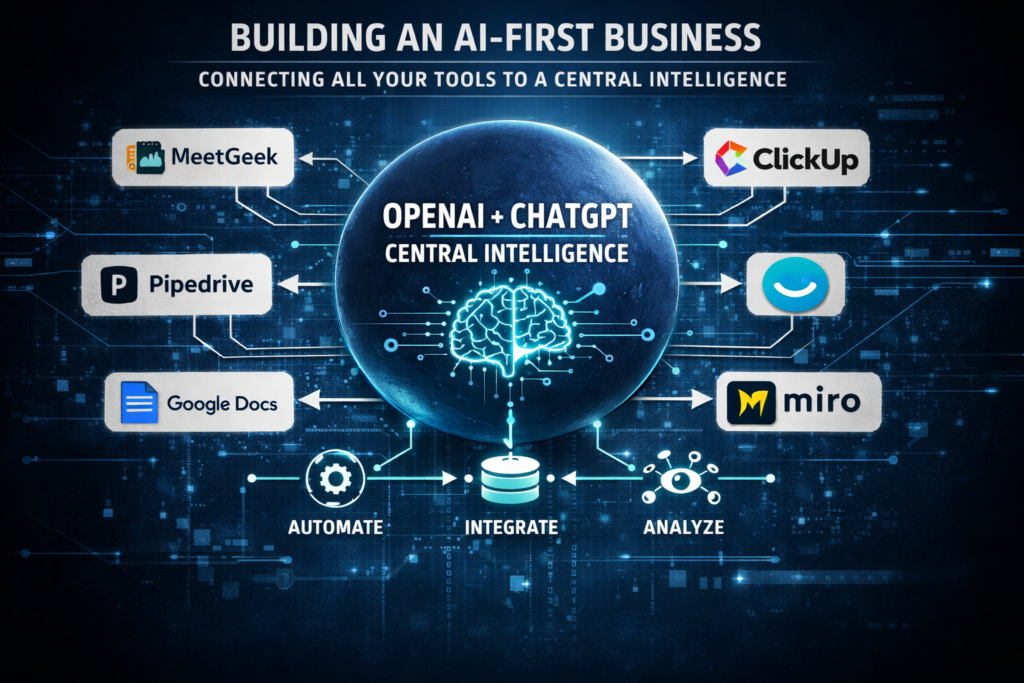
The core reasoning layer is:
OpenAI and ChatGPT
Everything else feeds into it and receives outputs from it.
Meeting intelligence
MeetGeek captures transcripts, summaries, and key points.
AI extracts:
• actions
• risks
• opportunities
• follow ups
These are then structured and sent to the right systems.
Operational execution
ClickUp is the task and delivery engine.
AI creates tasks, assigns owners, sets priorities, and links them to deals and documents.
Sales intelligence
Pipedrive holds structured pipeline data.
AI analyses:
• deal health
• next best action
• forecast confidence
• stalled opportunities
Then pushes tasks into ClickUp and generates follow up drafts.
Knowledge and deliverables
Google Docs stores proposals, reports, and client outputs.
AI drafts documents using context from meetings, CRM data, and project plans.
Visual thinking and discovery
Miro holds workshop artefacts and discovery outputs.
AI converts boards into:
• structured requirements
• roadmaps
• project plans
• statements of work
Financial reality
Xero provides revenue, cost, and cash flow data.
AI can connect delivery progress to commercial performance and flag risks early.
Example end to end workflow
A client meeting is recorded.
MeetGeek produces a transcript.
AI extracts actions and decisions.
Tasks are created in ClickUp.
Notes are attached to the relevant deal in Pipedrive.
A proposal draft is generated in Google Docs.
Revenue impact is reflected in forecasts.
Cash flow implications are checked against Xero.
No manual copying.
No lost context.
No duplicated effort.
Tool selection criteria for AI first businesses
When choosing software today, the questions should be:
Does it have an API?
Does it support webhooks?
Can I access structured data?
Can an AI read and write to it?
Can it participate in automated workflows?
If not, it will become a dead end in an AI driven architecture.
User interface and price still matter, but integration capability now determines long term value.
The operating model, AI as an orchestration layer
The real shift is this:
AI is not a feature.
AI is the orchestration layer.
Your tools become execution environments.
Your AI becomes the coordinator.
It reads, decides, and triggers actions across the stack.
That is how small businesses scale without adding headcount.
Where this is going, MCPs and central intelligence
As Model Context Protocol ecosystems mature, we will see:
Standardised connectors
Shared organisational memory
Persistent context across tools
AI agents that operate across the entire business
The companies that design their stack for this now will move faster later.
Practical starting point for small businesses
You do not need to rebuild everything.
Start with:
Choose a central AI platform
Connect your meeting notes
Connect your CRM
Connect your task manager
Automate one end to end workflow
Then expand.
Final thought
Do not just add AI to your tools.
Design your tools around your AI.
That is the difference between automation and an AI-first operating model.