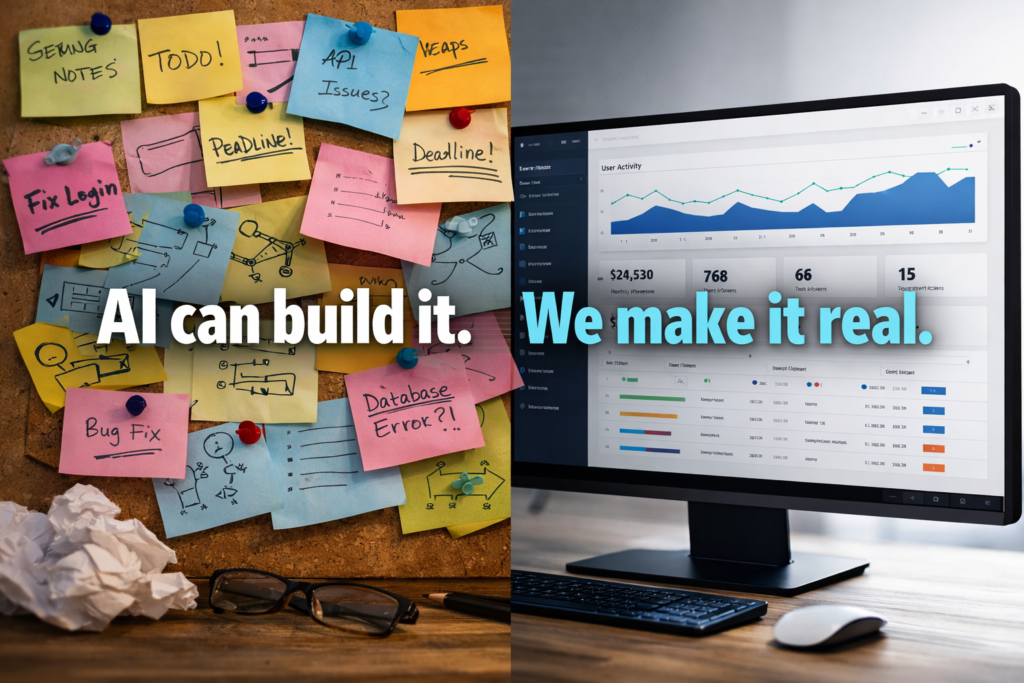
What humans still do better than AI
1. Turning vague ideas into a buildable plan
Most failed builds fail before the first line of code. A good consultant pulls the real requirements out of the noise and turns them into a practical plan.
That usually starts with questions like:
- Who is this for, and what do they do today?
- What does “done” look like in real terms?
- What systems are involved, and who owns them?
- What data is required, and what is sensitive?
- What are the failure points, and what’s the impact?
AI can ask questions too, but an expert knows which questions matter most, and how to turn answers into a sequence of steps you can actually execute.
2. Knowing what to build first, and what not to build
AI will happily build whatever you ask for. A pro helps you avoid building the wrong thing first.
You get help with:
- Cutting scope without losing the outcome
- Choosing the simplest solution that will actually stick
- Avoiding feature creep that kills timelines
- Designing for adoption, not just functionality
This is where speed really comes from. The fastest project is the one you don’t have to rebuild.
3. Working with your real stack, not an ideal fantasy stack
Most businesses already run on a mix of tools. The value is knowing what to ask for, what access is needed, and what is risky or brittle.
- Microsoft 365 or Google Workspace
- A CRM
- Accounting software like Xero or MYOB
- Job management tools
- Shared drives full of PDFs and spreadsheets
- Permissions, access rules, staff turnover, and process drift
AI does not naturally understand your environment unless you guide it perfectly, and most people don’t know what to tell it until it’s too late.
4. Testing that matches real-world risk
AI can generate tests, but testing is not just “does it run?” Real testing is about risk and edge cases.
Real testing looks like:
- Does it handle weird inputs?
- Does it fail safely?
- Does it duplicate data?
- Does it send the wrong email?
- Does it break when two staff use it at once?
- Does it still work when an API rate limit hits?
A professional approach builds in:
- Acceptance criteria tied to your workflow
- Test cases based on real usage
- Staging environments for safe testing
- Regression testing so fixes don’t create new problems
5. Deployment, security, and keeping it alive
The gap between “it works on my laptop” and “it runs reliably for a team” is huge. This is the part many DIY builds underestimate.
A proper delivery includes:
- Secure deployment (hosting, access, secrets, permissions)
- Backups and recovery plans
- Monitoring and alerts
- Performance and cost control
- Documentation and handover
- Ongoing support and improvements
AI does not take responsibility when something breaks. Humans do.
Why hiring an AI agency can be cheaper than doing it yourself
DIY plus AI often looks like this:
- You build something quickly
- It mostly works
- It hits a real-world edge case
- You patch it
- Another edge case appears
- It grows into a fragile mess
- You either rebuild, or you live with tech debt forever
You pay either way, you just pay later, and usually with more stress. Hiring an agency is not about paying someone to type code, it’s about avoiding expensive wrong turns.
Where AI Answers fits in
We’re the “make it real” layer. We use AI to move fast, and we bring the human part that actually matters:
- Discovery and planning
- Workflow design
- Technical decisions and tradeoffs
- Testing and reliability
- Security and safe deployment
- Integration with your current systems
- Training and handover
- Ongoing improvement
AI is the engine, humans drive.
A few practical examples
Example 1: A customer-facing assistant
DIY: You can spin up a chatbot this weekend.
Reality: If it gives the wrong answer, misses lead capture, or can’t escalate properly, it damages trust.
Our human-led version includes:
- Approved knowledge sources and guardrails
- Escalation paths to a real human
- Lead capture into your CRM
- Reporting so you can improve it
- Safe handling of sensitive info
Example 2: Document processing and admin automation
DIY: You can extract data from PDFs.
Reality: It fails on odd formats, messy scans, and unusual cases, and then staff stop trusting it.
Our human-led version includes:
- Ingestion and classification
- Confidence scoring and human review where needed
- Audit trail
- Exception handling
- Integration into your finance or ops tools
Example 3: Internal knowledge and onboarding
DIY: You can create an internal AI that answers questions.
Reality: Without permissions and source control, it becomes a privacy risk and a misinformation machine.
Our human-led version includes:
- Permissioned access
- Source linking and “show your work” answers
- Content update process
- Analytics on what staff ask
- Continuous improvement loop
The simple rule
If you’re building a prototype for yourself, DIY with AI is often perfect. If it touches customers, money, privacy, compliance, or core operations, you want a professional involved.
Not because AI is useless, but because outcomes require judgement and accountability.
What to do next
If you’re thinking, “I can probably build this, but I’d rather get it right fast,” you’re exactly who we help.
Option 1: Free 30-minute AI conversation
Bring your idea, your pain point, or your half-built prototype. We’ll help you get clarity on:
- What’s worth building
- What to avoid
- What the quickest path to ROI looks like
Option 2: Paid discovery workshop and recommendations
We map your workflows, systems, constraints, and opportunities, then you get a practical plan you can actually execute.
Option 3: Build, integrate, deploy, support
If it makes sense to build, we can deliver the full solution, including:
- Integrations
- Testing
- Deployment
- Documentation and handover
- Ongoing improvements
AI can code. We make it work in the real world.